Iodixanol : High‑Purity Low‑Endotoxin Reagent – From Clinical Contrast Agent to Reliable Density‑Gradient Medium for Cell Isolation
Aug 27, 2026
Introduction
Well‑known as a clinical non‑ionic X‑ray contrast agent, Iodixanol gains growing adoption within life‑science research for its unique physical‑chemical properties. Thanks to iso‑osmotic feature and excellent density stability, high‑purity low‑endotoxin iodixanol can form gentle density gradients without damaging cell membrane integrity, making it ideal for cell isolation workflows within cell‑culture research settings.
Many research teams and reagent distributors source general‑grade iodixanol repurposed from clinical raw‑material channels. Without strict control of endotoxin, free iodide and related impurities, these batches often cause reduced cell viability, spontaneous cell activation and poor experimental repeatability. Beyond performance, global buyers also raise practical concerns around documentation compliance, batch consistency, export lead‑time and traceability. Drawing from our in‑house purification production and batch COA testing experience, this article sorts out key quality metrics and real‑world procurement tips for researchers, CRO labs and specialty reagent distributors.
Core Quality Specifications of High‑Purity Iodixanol
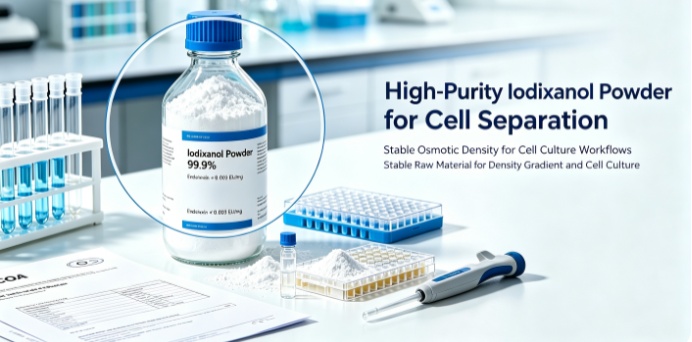
This high‑grade Iodixanol reaches 99.9% assay. Endotoxin is strictly controlled at <0.003 EU/mg calculated on iodine basis — the most critical index for cell‑related research applications. Referencing typical batch COA documentation: free iodide <0.05%; related compound D ≤0.1 % (Not Detected in qualified finished batches); unspecified related substances not detected; water content ≤0.03 %. Microbial bioburden is kept below 10 cfu/g. Products comply with USP monograph requirements alongside our internal enterprise specifications.
From factory production feedback: residual free iodide, trace organic impurities or elevated endotoxin, which are acceptable for some clinical contrast material batches, will create cytotoxic risks for sensitive primary cells and stem‑cell samples. Additional targeted purification steps are required to bring these parameters up to research‑grade standards for cell‑isolation work. Each manufacturing batch undergoes full testing before release to secure lot‑to‑lot consistency for repeat orders.
Core Application Scenarios & Practical Production Insights
Density‑Gradient Cell Isolation for Cell‑Culture Research
Although originally developed as radiological contrast media, iodixanol’s biggest advantage for laboratory work lies in its iso‑osmotic density property. It can build continuous or discontinuous density gradients under physiological osmotic pressure conditions. During centrifugation, cells are separated according to buoyant density without osmotic shock, maintaining intact cell activity for subsequent cell‑culture incubation.
Common use cases include isolation of peripheral blood mononuclear cells, stem cells and other fragile cell populations. Real‑world lab observations show: materials with insufficient impurity control lead to obvious cell loss after centrifugation. High‑purity low‑endotoxin iodixanol preserves cell membrane integrity, improves recovery rate of target cells, and delivers consistent results across different experimental batches. It serves as the pre‑processing step prior to downstream cell‑culture operations, rather than being a direct cell‑culture medium additive.
FAQ
Q1: Why cannot ordinary clinical‑grade iodixanol be directly used for cell‑isolation experiments?
A: Clinical contrast‑agent raw materials satisfy imaging requirements, yet they do not set strict limits for endotoxin calculated on iodine basis. Even low‑level endotoxin may trigger non‑specific activation of immune‑related cells, affecting experimental reliability. Research‑oriented batches require extra purification to hit <0.003 EU/mg (iodine‑based) specification.
Q2: What negative impact does excessive free iodide exert on cell‑separation experiments?
A: Excess free iodide introduces chemical cytotoxicity. After gradient centrifugation treatment, it reduces cell survival rate. Qualified research‑grade iodixanol controls free iodide below 0.05 % to avoid this risk.
Q3: What export‑related documentation can you provide for global buyers?
A: Every shipment comes with batch‑specific COA, packing list, commercial invoice. We support providing compliance documents for your customs clearance. Sample quantities are available for lab pre‑validation; MOQ, lead‑time and unit pricing will be shared upon formal inquiry. This product is intended for research use only, not for human clinical application.
Conclusion
Iodixanol originates as a classic X‑ray contrast agent. After precise purification and strict impurity management, it becomes a powerful density‑gradient reagent for cell‑isolation workflows within cell‑culture research. Assay value, endotoxin level, free iodide, related‑substances and microbial limits collectively determine experimental reliability.
Consistent lot performance and complete export documentation are equally important for distributors and research institutes sourcing internationally. If you are evaluating iodixanol for cell separation projects, you may reach out to obtain sample information and detailed specification package for your internal qualification.

 English





 Network Supported